How AllMeters AI Reads a Real Water Meter — Step by Step
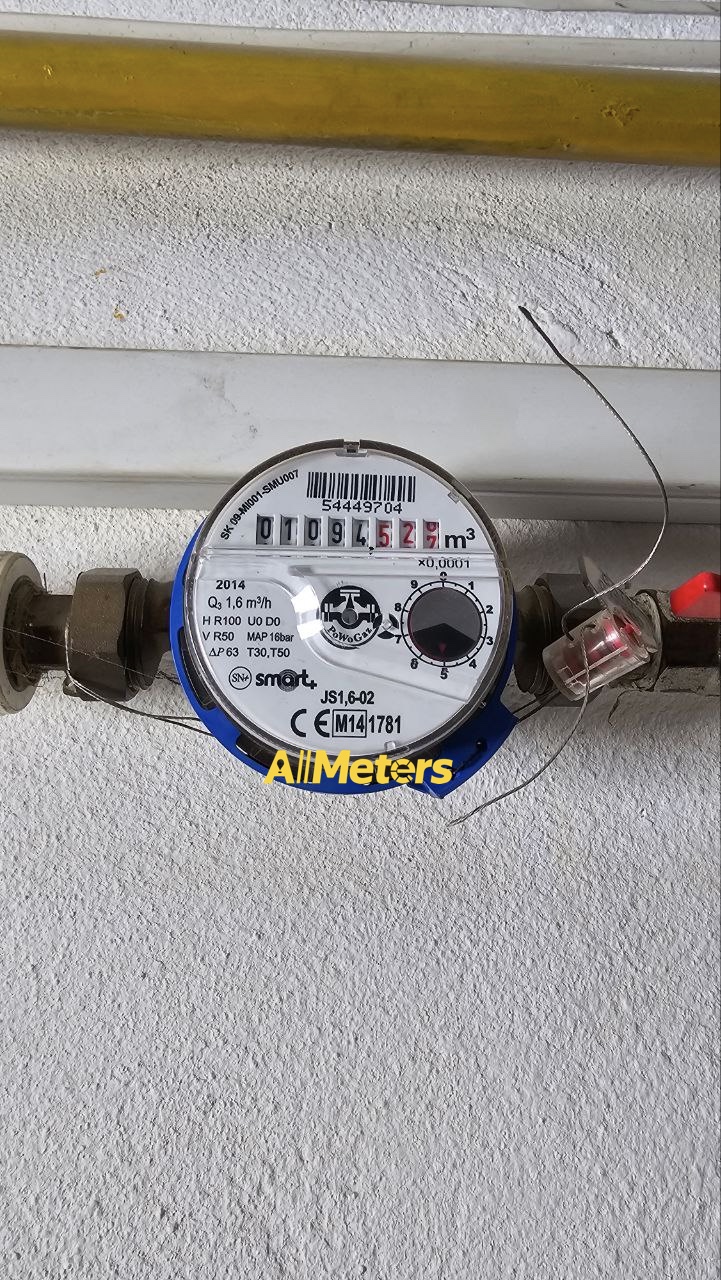
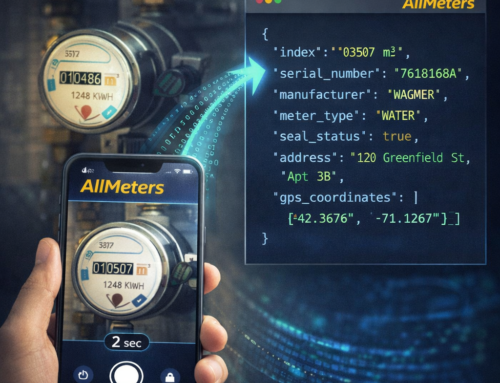
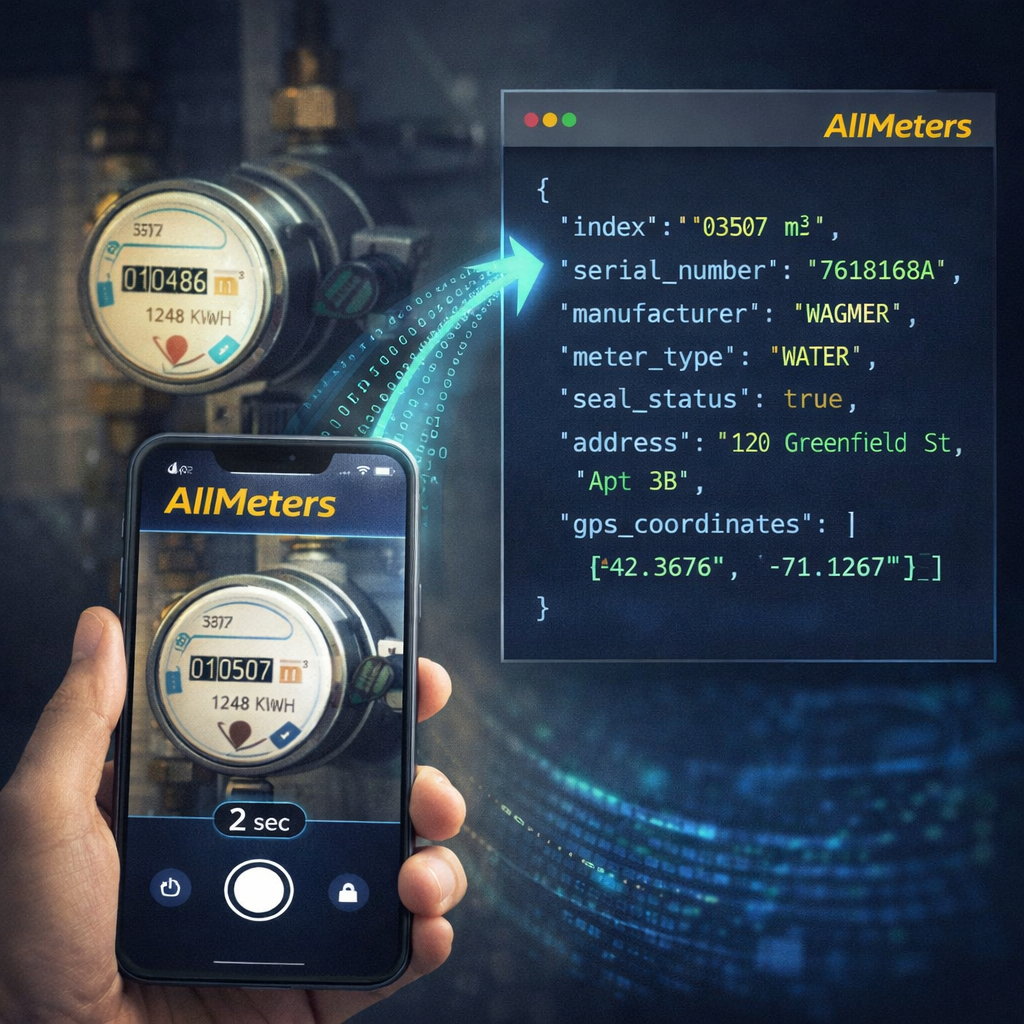
Water meters present some of the most challenging conditions for AI-based meter reading: they are often installed in basement meter rooms with poor lighting, behind plastic covers with accumulated condensation, or in outdoor cabinets exposed to weather. This post walks through a real water meter analysis using the AllMeters AI pipeline — from a single smartphone photograph to a complete, verified reading.
Why Water Meters Are Different
Compared to electricity and gas meters, water meters have distinct characteristics that require specialized AI handling:
- Wet environments: Condensation inside the meter housing is common, especially in underground installations. Water droplets on the glass scatter light and partially obscure digit wheels.
- Mechanical digit wheels: Most Romanian residential water meters use mechanical odometer-style digit wheels rather than digital displays. The AI must read analog wheels rather than backlit LCD segments.
- Variable digit count: Water meters range from 5-digit to 8-digit displays depending on meter capacity (nominal diameter DN15 through DN50).
- Red decimal digits: Many water meter formats use red digit wheels for the decimal portion (tenths and hundredths of cubic meters). The AI must distinguish red wheels from black wheels to correctly position the decimal point.
- Age and wear: Romanian water infrastructure includes meters that are 15–20 years old. Worn digit wheels, faded markings, and accumulated scale deposits are common.
Stage 1: Meter Detection in Difficult Conditions
The AllMeters detection model was trained specifically to locate water meter displays under the conditions described above. Unlike generic object detection models, it handles:
- Partial meter covers (plastic protective shields partially moved aside)
- Shared meter cabinets where multiple meters appear in the same photograph
- Reflective meter glass causing bright specular highlights
- Underground installation angles where the camera cannot be positioned directly above the meter
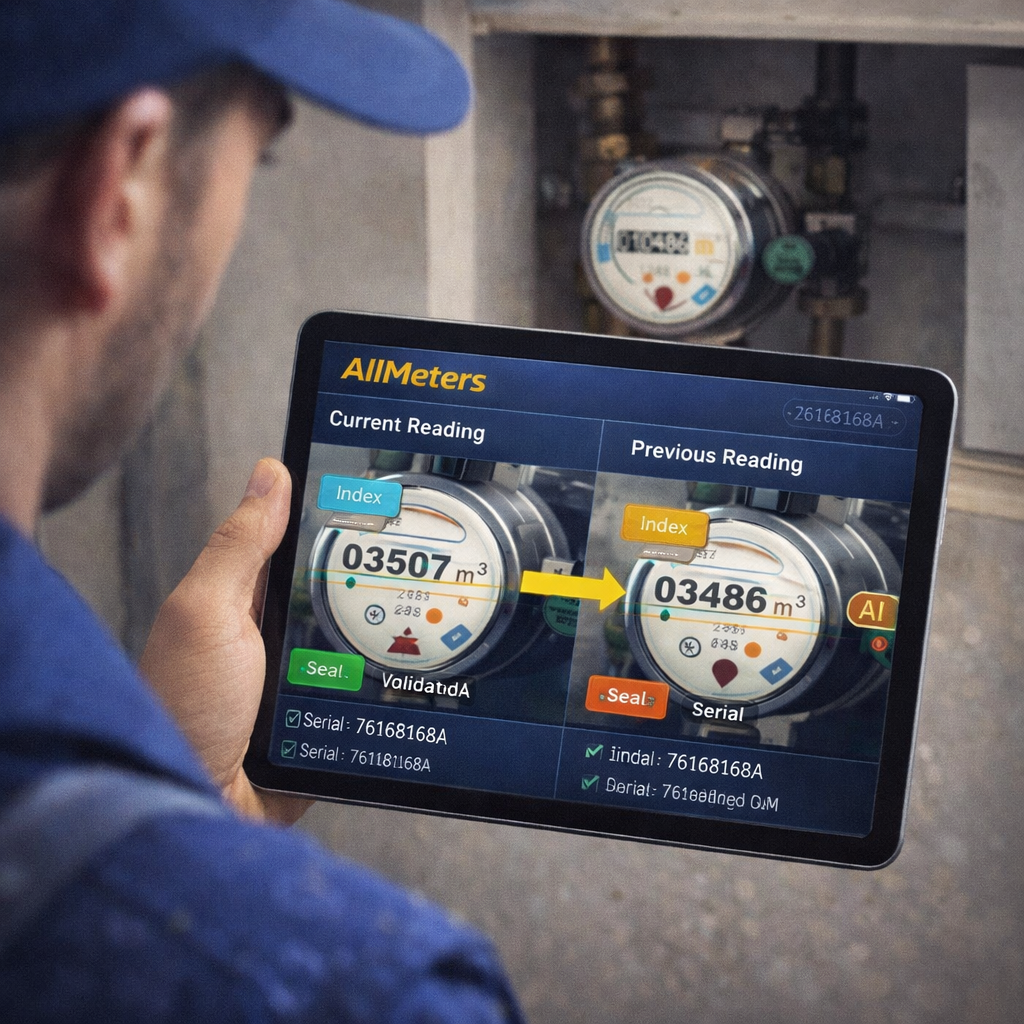
When multiple meters are visible in the frame, the AllMeters app highlights each detected meter and asks the reader to confirm which one is being read. This prevents misattribution in apartment building common areas with side-by-side meter installations.
Stage 2: Reading the Digit Wheels
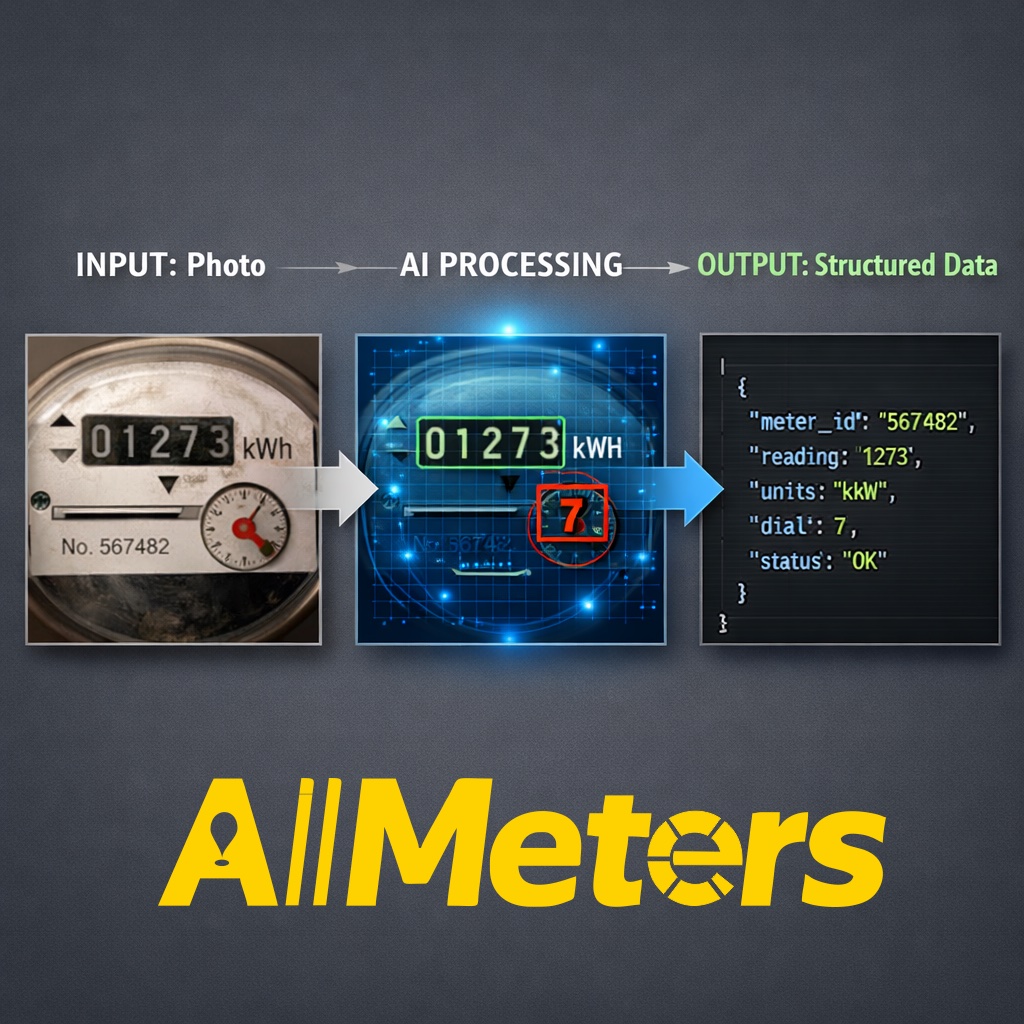
For mechanical digit wheel meters, the OCR pipeline uses a different approach than for digital displays. Each wheel is analyzed individually:
- Wheel segmentation: The display region is divided into individual wheel columns based on the mechanical housing structure.
- Digit classification: Each wheel is classified as showing a digit 0–9. The model handles partially-turned wheels (where a digit is mid-transition between positions) by selecting the closest completed digit.
- Color classification: Wheels are classified as black (integer cubic meters) or red (decimal liters). The decimal position is determined by the transition between black and red wheels.
- Rollover detection: If the reading appears lower than the previous reading on record, the system flags a potential rollover (meter has reached maximum and reset to zero) rather than treating it as an error.
A typical result for a residential DN15 water meter:
{
  "reading": {
    "index": "00847.320",
    "unit": "m³",
    "integer_digits": 5,
    "decimal_digits": 3
  },
  "meter_id": {
    "serial_number": "RO-AP-2017-008473",
    "manufacturer": "Apator",
    "model": "JS 1.6",
    "nominal_diameter": "DN15",
    "production_year": 2017,
    "max_flow": "3 m³/h"
  },
  "verification": {
    "seal_present": true,
    "seal_intact": true
  },
  "confidence": 0.96
}
Stage 3: Manufacturer and Model Identification
The AllMeters identification model recognizes all water meter manufacturers common in Romanian utility infrastructure:
| Manufacturer | Common Models | Market Segment |
|---|---|---|
| Apator | JS 1.6, JS 2.5, Ultrimis W | Residential, light commercial |
| Zenner | EDC, MTKD-N, ETKD-P | Residential, multi-jet |
| Sensus | 620, iPERL | Residential to large commercial |
| Itron | Flostar M, Aquadis+ | Residential, cold water |
| Elster | V100, V200 | Residential, volumetric |
| Ningbo Water Meter | LXSG, LXLG | Residential, imported |
For meters from manufacturers not yet in the training dataset, the system still extracts the reading with full accuracy — manufacturer identification falls back to “Unknown” while the index reading proceeds normally.
Stage 4: Leak Detection Signal
Water meters equipped with a leak indicator (a small rotating disc or star wheel visible through the display glass) allow the AllMeters AI to detect potential leaks at reading time. If the leak indicator disc is visible and appears to be in motion (even in a still photograph, motion blur is detectable), the reading is flagged with "leak_indicator": "active".
This signal is particularly valuable for utility providers: a leak indicator active at the time of a routine reading may indicate internal household pipe leakage that the resident has not yet noticed. Proactive notification reduces water losses and builds customer loyalty.
Accuracy on Water Meters
AllMeters achieves 99.4% reading accuracy on water meters — the highest of the three supported meter types. The higher accuracy compared to electricity (99.0%) and gas (99.1%) meters is attributed to the larger digit size relative to display area on most residential water meters and the well-defined red/black color boundary that assists decimal positioning.
Validation was performed on a dataset of 6,200 water meter readings from Romanian municipal water utilities, with ground truth provided by manually verified human readings. Test conditions deliberately included difficult cases: condensation (18% of samples), worn digits (12%), adverse lighting (23%), and extreme angles (9%).
Processing Time
- Median end-to-end time: 287 ms (slightly faster than electricity meters due to lower display complexity)
- P99 time: 451 ms
- Offline capability: The on-device model processes water meters entirely offline — no internet connection required at the time of reading
Try It Now
Test the AllMeters AI on your own water meter via the Telegram bot at t.me/AllMetersBot — send a photo of any water meter and receive the full structured analysis within 2 seconds. No registration required for the demo.
For utility providers and property managers interested in bulk integration, contact contact@all-meters.com or explore the Cloud API subscription plans.
👉 www.all-meters.com



Leave A Comment
You must be logged in to post a comment.